Sea Freight Rates in Malaysia: Cost Breakdown for Importers
Introduction
Understanding sea freight rates Malaysia is an essential skill for any small business owner planning to import goods by sea. With Malaysia’s strategic position as a shipping hub, most products arrive via ocean, offering cost-effective logistics solutions for businesses of all sizes. However, the process is not always straightforward—shipping cost Malaysia involves multiple components that can surprise even experienced entrepreneurs. This detailed how-to-guide will help you untangle freight charges Malaysia, learn how ocean freight rates are calculated, and empower you to make smarter, more profitable import decisions.
Why Sea Freight Matters for Malaysian Small Businesses
For Malaysian small businesses, leveraging sea freight holds the key to competitive pricing and growth. Unlike air freight, which is mostly reserved for lighter and urgent deliveries, sea freight allows you to move large volumes at a fraction of the cost. The flip side: pricing models are complex and can be riddled with hidden charges, making it easy to miscalculate your true costs.
The Strategic Advantage
- Cost Efficiency: Sea transport is considerably cheaper per kilogram compared to air freight. For example, shipping a pallet of electronics by air can easily cost five times more than the equivalent ocean shipment.
- Scalability: As your import volume grows, shifting to full container loads (FCL) maximizes efficiency.
- Global Reach: Access to major Asian and international ports enhances sourcing options.
Business Impact Example
Ali operates a stationery import business in Kuala Lumpur. Initially, he relied heavily on air shipments to meet his customers’ tight deadlines. After analyzing his annual logistics expenses, he realized he could save up to 60% by transitioning to monthly sea shipments for non-urgent stock. The savings allowed him to offer better prices and invest in new product lines.
Understanding Sea Freight Rates in Malaysia
Getting a grip on sea freight rates Malaysia requires an understanding of how sea logistics functions globally and the specific context of Malaysian ports.
The Basics of Sea Freight
Sea freight refers to the shipment of goods in containers on cargo ships across international waters. Shipments move from the exporter’s port (origin) to the importer’s destination port—such as Port Klang, Penang Port, or Johor Port.
How Does It Work?
- Goods are packed and loaded into shipping containers.
- Containers are transported to the port and loaded onto vessels.
- Ships transit to the destination port.
- Containers are offloaded, cleared through customs, and transported inland.
Types of Shipping Containers
Selecting the right container size and shipping pattern dramatically affects your shipping cost Malaysia.
Full Container Load (FCL)
- 20-foot (TEU): Typically holds up to 28 tons or 33 cubic meters. Ideal for small- to medium-sized businesses with moderate volume.
- 40-foot (FEU): Holds about 56 tons or 67 cubic meters. Suited for large shipments and bulk goods.
Less-than-Container Load (LCL)
For smaller shipments, your cargo shares container space with other importers. You pay only for the volume/weight of goods shipped. Best for start-ups or infrequent shipments.
Special Containers
- Reefer Containers: For temperature-sensitive cargo—expect higher ocean freight rates.
- Open Top/Flat Rack Containers: For oversized or heavy machinery, costs are significantly higher due to specialized handling.
Container Choice Example
Tan, a retailer in Ipoh, began importing home décor in LCL shipments. As his sales grew and he reached 70% of a 20ft container per order, his forwarder recommended switching to FCL. The per-unit freight charge dropped by almost half, making his pricing more competitive.
Core Components of Ocean Freight Rates
Many importers mistakenly believe the base freight rate is all-inclusive. In reality, freight charges Malaysia consist of several elements—some predictable, some not.
Base Freight Rate
This central fee covers the sea journey from the origin to the destination port. Costs vary depending on:
- Shipping lane and port pair (e.g., Ningbo to Port Klang versus Rotterdam to Penang)
- Container type and size
- Carrier and shipping alliance (e.g., Maersk, MSC, ONE)
- Contracted vs. spot rates (long-term fixed contracts are usually cheaper than volatile spot rates)
Rate Trends
- In 2023, 20ft container rates from China to Port Klang averaged USD 400–700 (MYR 1,800–3,150).
- Rates are higher during peak seasons (before Chinese New Year, Christmas, Hari Raya).
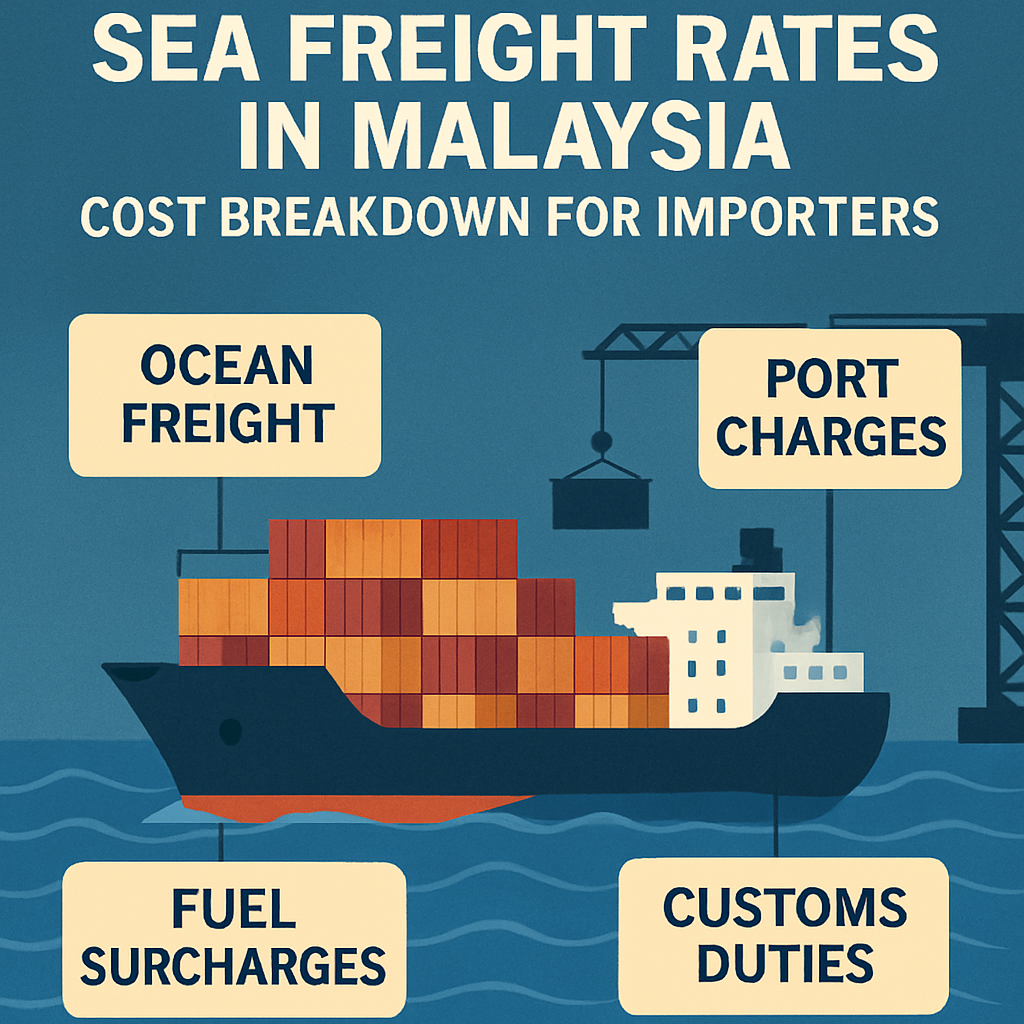
Surcharges and Fees
- Bunker Adjustment Factor (BAF): Adjusts for fuel price fluctuations.
- Currency Adjustment Factor (CAF): Offsets currency risk between USD and MYR.
- Peak Season Surcharge (PSS): Applied during high demand periods.
- Emergency Risk Surcharge (ERS): Covers emergencies like port strikes or blockages.
Port Charges and Delivery
- Terminal Handling Charges (THC)
- Documentation Fee
- Delivery Order Fee
- Container Cleaning and Seal Charges
Additional/Hidden Costs
- Detention Charges
- Demurrage
- Customs Duties and Sales Service Tax (SST)
- Inland Transportation
Hidden Cost Warning Example
Sarah, who imports luxury tiles for her boutique in Melaka, was once charged over MYR 1,200 in detention fees when customs inspections delayed her clearance by a week. Now, she works closely with her forwarder to ensure all documentation is flawless before every shipment.
Breakdown of Freight Charges in Malaysia
Real-World Data and Typical Rates
Example 1: Shipping from Shenzhen, China to Port Klang
| Cost Component | Typical Range (20ft) | Details |
|---|---|---|
| Ocean Freight | USD 400–700 (MYR 1,800–3,150) | Fluctuates seasonally |
| Terminal Handling Charges (THC) | MYR 280–420 | At both origin and destination |
| Documentation Fee | MYR 120–170 | Export/import paperwork |
| Delivery Order Fee | MYR 100–200 | To release cargo |
| Customs Clearance/Broker | MYR 200–300 | Excludes actual duties |
| Trucking (Port Klang – KL) | MYR 450–900 | Depends on route/congestion |
| Container Deposit | MYR 500–800 | Refundable (if container returned on time) |
| Insurance | ~0.3% of cargo value | Optional, strongly recommended |
| SST/Duties | 0–30% | Based on product (HS code) |
Estimated Total: All-inclusive, a single 20ft container may cost between MYR 3,300 and MYR 8,000.
Example 2: LCL Shipment from Ho Chi Minh City to Penang Port
| Cost Component | Typical Range (per CBM) | Notes |
|---|---|---|
| Ocean Freight (LCL base) | USD 60–110 (MYR 270–500) | Min. 1 CBM charge |
| THC | MYR 80–120 | Per cubic meter |
| Documentation Fee | MYR 70–120 | Per shipment |
| Customs Clearance | MYR 120–200 | |
| Trucking (Port–warehouse) | MYR 150–300 | Usually within Penang |
| Groupage Fee | MYR 30–50 | Shared handling fees |
For a 3 CBM shipment, total charges may land between MYR 1,300 and MYR 2,100.
Factors Influencing Freight Costs
- Shipping Route & Distance
- Container Type and Volume
- Seasonal Demand
- Fuel and Exchange Rates
- Product Type or Classification
- Port Congestion and Operational Delays
Case Study: Impact of Peak Season
During the 2022 year-end rush, Jenny, an apparel importer in Johor Bahru, saw her ocean freight spike from USD 500 per container in August to USD 1,100 in November. She learned to plan orders for earlier shipping windows to avoid seasonal surcharges.
Real Stories: Small Business Experiences
Shanti’s Sourcing Story
Shanti, founder of a furniture importing business, negotiated her first major order from Vietnam. Her initial quote for ocean freight was MYR 2,900. After receiving her invoice, she discovered additional THC of MYR 450, documentation charges of MYR 120, and a customs agent fee. She realized the importance of asking for an ‘all-in’ quote.
Ahmad’s Bulk Import Turnaround
Ahmad, in the home décor trade, started with monthly LCL groupage shipments from China. Noticing high per-CBM costs, he joined a local importers’ WhatsApp group and participated in bulk purchases. By switching to FCL with group consolidation, he dropped his import costs by nearly 30% and increased his margin while maintaining supply reliability.
Hafiza’s Lesson on Demurrage
Hafiza’s Kuala Lumpur-based electronics venture imported a full container from Taipei. Unfamiliar with local port customs procedures, her goods were delayed, incurring MYR 800 in demurrage fees. “I trusted my supplier to do everything,” she says. Now, she ensures her paperwork is pre-cleared online and works directly with a Malaysian customs broker to streamline arrivals.
Xavier’s Experience with Reefer Containers
Xavier’s gourmet food business started importing French cheeses by sea. The additional charge for reefer containers was steep—about 2.5 times higher than dry containers. However, by negotiating free storage days at the port with his forwarder and optimizing clearance times, he reduced temperature maintenance surcharges and avoided any spoilage costs.
How to Reduce Shipping Costs: Practical Tips
- Plan and Book Early
- Get Multiple Quotes
- Consolidate Shipments
- Negotiate Charges and Conditions
- Understand and Use INCOTERMS Wisely
- Accelerate Customs Clearance
- Choose the Optimal Port
- Pack and Load Efficiently
- Insure Your Cargo
- Build Relationships with Trusted Agents
Cost Saving Example
Julian, owner of a Johor-based Christmas decorations company, orders goods in late summer instead of autumn. “I save over MYR 1,000 per container just by avoiding peak November rates,” he reports.
Step-by-Step Guide to Estimating Your Shipping Cost in Malaysia
- Define Shipment Details
- Gather Base Ocean Freight Quotes
- Request Surcharges List
- Factor in Port and Customs Charges
- Calculate Inland Delivery
- Add Insurance
- Allow for Ad Hoc or “Buffer” Expenses
Sample Calculation: FCL 20ft from Shanghai to Port Klang
- Ocean freight: MYR 2,500
- Terminal handling (Malaysia): MYR 300
- Documentation: MYR 120
- Delivery order: MYR 140
- Customs clearance: MYR 180
- Trucking (to Petaling Jaya): MYR 600
- Insurance: MYR 90
- Goods and SST duties: MYR 1,200
- Buffer: MYR 250
Grand total: MYR 5,180
Quick Checklist for Small Business Importers
- [ ] Did I get a complete, itemized quote?
- [ ] Which charges are prepaid, and which are collect on arrival?
- [ ] Have I clarified responsibility for customs/SST/duties?
- [ ] Am I eligible for trade agreements or duty exemptions?
- [ ] What’s the demurrage and detention policy of my shipping line or forwarder?
- [ ] Is my cargo adequately insured?
- [ ] Are my suppliers or forwarders responsive and transparent?
Frequently Asked Questions
Q1: Is it always more economical to ship FCL than LCL?
A: Not always, but generally, FCL becomes cheaper per unit when you can fill at least 70% of a container.
Q2: Why do sea freight rates fluctuate so much?
A: Ocean freight rates are highly sensitive to global events, oil prices, seasonal demand, and supply chain disruptions.
Q3: Can local handling charges be waived or reduced?
A: Some forwarders can negotiate better THC or waive certain documentation fees for regular customers.
Q4: When are the best and worst times to book sea freight in Malaysia?
A: Best: Off-peak periods (March–April, August–September).
Worst: 2–3 months before major global holidays.
Q5: How can I avoid paying demurrage and detention charges?
A: Be proactive—complete documentation early