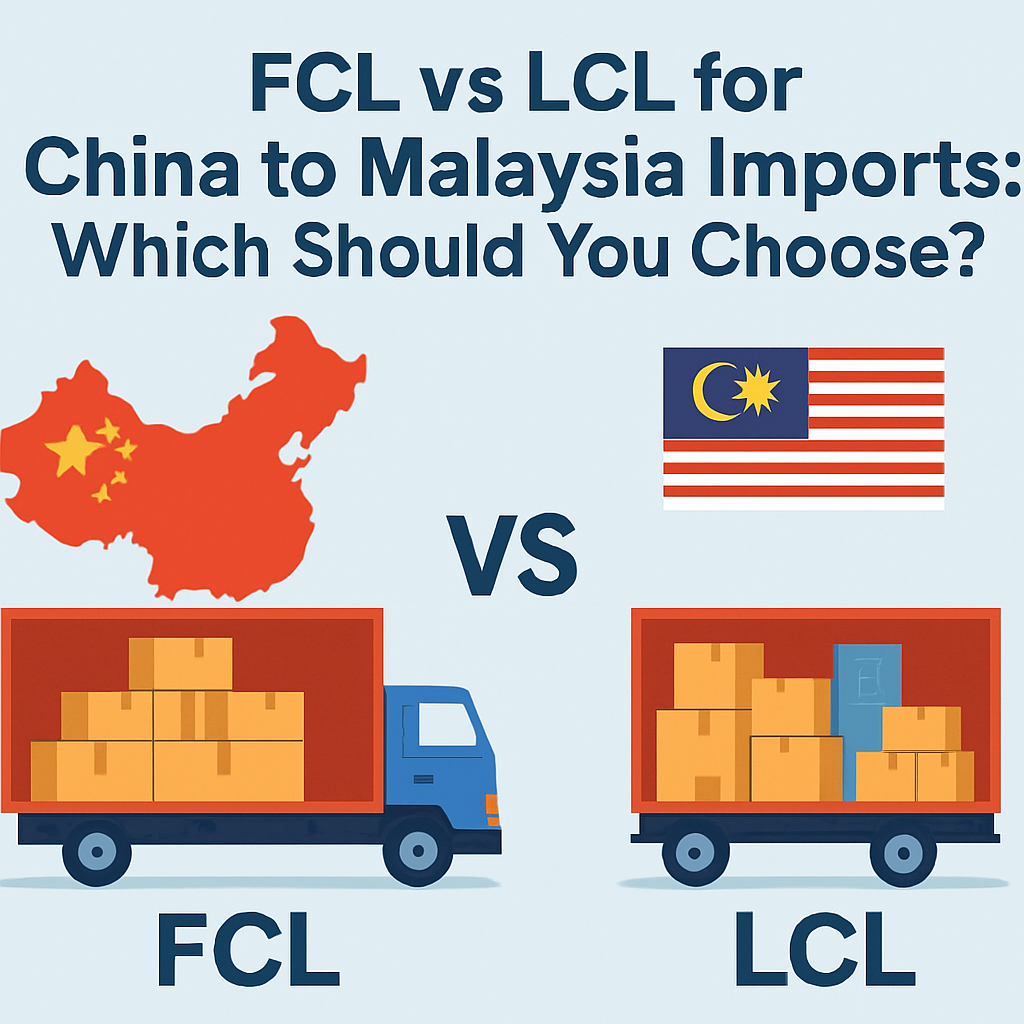
FCL vs LCL for China to Malaysia Imports: Which Should You Choose?
Importing goods from China can supercharge the growth of your Malaysian small business—but between FCL (Full Container Load) and LCL (Less than Container Load), deciding on the best shipping method can be tricky. This crucial choice affects your shipping costs, the speed and safety of your shipment, and the ease of your supply chain management. For new and established small business owners alike, understanding the differences between FCL and LCL, alongside recent trends in ocean freight Malaysia, ensures your products reach you dependably and cost-effectively.
In this comprehensive, comparison-driven guide, we’ll break down FCL vs LCL China to Malaysia shipping options, using real business stories, hands-on case studies, and the latest industry insights to help you make the right call for your unique needs. Whether you source niche products for an online shop or bulk stock for retail, this guide will empower you to optimize your import logistics and enhance your competitive advantage.
Table of Contents
- Introduction to Container Shipping Malaysia
- Understanding FCL and LCL: What Do They Mean?
- Comparing FCL vs LCL China to Malaysia: Deep Dive
- Advantages and Disadvantages: The Real Pros & Cons
- Key Decision Factors for Small Business Owners
- Case Studies & Real Business Stories in Malaysia
- Comprehensive Cost Breakdown: Ocean Freight Malaysia
- Step-by-Step Decision Guide
- Mistakes to Avoid: Lessons from the Field
- FAQs: Container & LCL Shipping Malaysia
- Conclusion: FCL vs LCL—Which Is Best for Your Business?
Introduction to Container Shipping Malaysia
With China holding its place as Malaysia’s top trading partner, efficient container shipping Malaysia is more vital than ever. According to the Port Klang Authority, in 2023, Malaysian ports handled an all-time high of over 24 million TEUs (Twenty-foot Equivalent Units), with a significant proportion of these containers originating from China’s major export hubs.
Why is this important for small business owners? As e-commerce and cross-border trade expand, having access to established shipping routes means you benefit from frequent sailing schedules, better service choices, and more competitive rates on both FCL and LCL shipping Malaysia options.
For a small business just starting out or scaling up, the ability to select the optimal shipping method can make or break your competitiveness—affecting not just your landed costs, but also your inventory turnover and customer satisfaction.
Understanding FCL and LCL: What Do They Mean?
What is FCL (Full Container Load)?
FCL means you (the consignee) book the entire container for your cargo. Most commonly, this is a 20-foot (about 28–30 CBM) or 40-foot (about 58–60 CBM) container.
How FCL Works
- Your goods occupy the entire container: Even if you fill only 60% of the space, you still pay the full rate.
- Secured exclusively for your shipment: No mixing with cargo from other consignees.
- Main FCL routes: Lines such as Maersk, COSCO, MSC, and Evergreen operate frequent sailings from leading Chinese ports (Shanghai, Ningbo, Shenzhen, Qingdao) to Malaysian ports (Port Klang, Penang, Pasir Gudang).
- Delivery process: Container loaded at the supplier’s facility (sometimes called “factory stuffing”), sealed, shipped, and delivered to you. Less handling reduces risk and simplifies tracking.
- Typical shipment sizes: Furniture wholesalers, electronic goods importers, or anyone whose shipment regularly exceeds 15 CBM often prefer FCL.
Example FCL Shipment
A Selangor-based home décor business imports 32 CBM of vases and lamps from Foshan. They book a 20FT FCL, ensuring their fragile goods remain untouched by third parties during transit—a vital safeguard against breakage.
What is LCL (Less than Container Load)?
LCL is the go-to choice if your shipment is much smaller than a full container’s volume.
How LCL Works
- Multiple shippers, one container: Your freight forwarder consolidates your goods with those of other businesses—splitting the cost.
- Pay only for Volumetric Usage: Charges are based on CBM (cubic meters), so you’re billed precisely for the space you use.
- Critical for new importers: No need to wait until you have enough stock to fill a container.
- LCL consolidation hubs: Major Chinese ports (Shanghai, Shenzhen, Yiwu, Guangzhou) run weekly LCL box sailings directly to Malaysia’s main terminals.
- Process: Your shipment goes to a consolidation warehouse in China, is grouped with others, and deconsolidated at a CFS (Container Freight Station) upon arrival.
- Typical users: Online sellers, boutiques, and businesses testing new product lines.
Example LCL Shipment
A Penang-based specialty tea retailer orders 4 CBM of assorted tea ware and gift sets from China using LCL. They only pay for the 4 CBM space, not a full container, keeping their upfront investment lower and reducing the risk of excess, unsold stock.
Comparing FCL vs LCL China to Malaysia: Deep Dive
When evaluating FCL vs LCL China to Malaysia for your import needs, consider the following key aspects.
Shipment Size and Logistics
- FCL is most efficient for shipments over 15 CBM (about half a 20FT container or more).
- LCL caters to smaller shipments—typically between 1 and 12–14 CBM.
Handling and Cargo Safety
- FCL: Minimal handling, only at origin loading and destination unloading. Lower chance of damage, pilferage, or loss.
- LCL: Multiple handling points due to consolidation and deconsolidation. Goods may be stacked with incompatible or heavy cargo, raising risks.
Transit Time
- FCL: Direct shipment, generally arrives 2–4 days quicker.
- LCL: Can be delayed during wait time for consolidation, loading, and at the destination CFS for group unpacking.
Cost Structure
- FCL: Flat rate per container, regardless of actual space used.
- LCL: Pay by CBM, but fees for documentation, handling, and consolidation are higher per unit volume.
Flexibility
- FCL: Less flexible; requires larger cash flow and more warehouse space.
- LCL: Highly flexible, perfect for variable order sizes, frequent restocking, and product testing.
Advantages and Disadvantages: The Real Pros & Cons
Pros and Cons of FCL
Pros
- Economical for Bulk: Lower cost per CBM above half-container volume.
- Speed Advantage: Direct, prioritized shipment; avoids delays of group cargo.
- Cargo Integrity: Single shipper’s cargo, less risk of tampering or damage.
- Simplified Customs: Fewer parties involved, easier and faster clearance.
- Scalability: Ideal as your business volumes grow.
Cons
- Higher Upfront Cost: Paying for the entire container—even if underfilled.
- Inventory Holding: Need to store large quantities/stock.
- Less Ideal for Infrequent Orders: Not suited to just-in-time or highly variable demand patterns.
Pros and Cons of LCL
Pros
- Low Entry Barrier: Start small and scale up–risk and investment minimized.
- Pay-As-You-Go: Only pay for your actual shipment volume.
- Higher Flexibility: Ship as needed, more frequently or in smaller batches.
- Inventory Efficiency: Holds less stock; reduces warehousing requirements especially valuable for fast-moving or seasonal goods.
Cons
- Higher Per-Unit Cost at Larger Volumes: Can get expensive for anything close to half or a full container.
- Increased Handling Risks: Goods are handled more often, increasing potential for breakage.
- Potential Delays: Grouping and degrouping take time, especially in peak seasons.
- Complex Customs: Higher likelihood of customs inspections and paperwork delays due to multiple consignees in a single container.
Key Decision Factors for Small Business Owners
Volume and Cargo Characteristics
- Calculate your average CBM per shipment.
- Example: A Klang Valley clothes importer sends 10 CBM per month—LCL is logical.
- But: At 18 CBM monthly, FCL offers a 25–35% cost per CBM savings.
Product Fragility & Risk Tolerance
- Fragile/expensive cargo: FCL minimizes exposure to third-party goods.
- Bulk, non-fragile—like textiles or plastics: LCL may suffice for low-risk, durable items.
Shipping Urgency
- Faster turnarounds needed (e.g. electronics for a big launch)? FCL’s direct routing makes a difference.
- Testing new products or seasonal items? LCL allows nimble, smaller orders.
Budget & Cashflow
- Heavy FCL users: Need more working capital—for both purchasing more stock and paying the full container in advance.
- Smart LCL users: Lower stock investment means cash on hand for product expansion or marketing.
Growth Strategy
- Forecast volume increases: Plan to switch from LCL to FCL when sustained shipments approach 13–15 CBM.
- Seasonality: Consider both options if your shipment sizes fluctuate during festive seasons or special sales campaigns.
Case Studies & Real Business Stories in Malaysia
Case Study 1: Growth Through FCL — Teong’s Fashion Trading
Teong runs a growing women’s apparel import business in Kuala Lumpur. When he started, he could only afford to import 7 CBM of stock per consignment, so he used LCL. As his sales grew, monthly orders exceeded 20 CBM. Teong switched to FCL, earning two key benefits:
- Cost-Savings: His logistics costs dropped from RM570/CBM (LCL) to only RM325/CBM (FCL).
- Improved Delivery: Average delivery time shrank by 5 days, keeping his hottest products in stock, boosting sales during peak Ramadan season.
Takeaway: Shifting to FCL at the right time maximized gross margin and customer satisfaction.
Case Study 2: LCL Flexibility — Sari’s Eco-Boutique
Sari, in Penang, curates eco-friendly gifts. Each month, she imports 3–5 CBM of bamboo utensils and tea sets from three suppliers in Guangzhou and Yiwu. LCL lets her:
- Sample a wider variety without investing in big stockpiles.
- Place multiple small orders per month, responding quickly to market trends.
- Avoid storage headaches in her small shop, since goods arrive in manageable batches.
Takeaway: For Sari, LCL is ideal for maximizing product diversity and cash flow efficiency.
Case Study 3: LCL Risks — Fragile Goods Gone Wrong
Kamal, a retail entrepreneur, ordered porcelain tiles (9 CBM) via LCL for his Melaka homeware store. On arrival, several crates were shattered due to poor stacking by another consignee’s steel pipes above his goods.
What went wrong?
- Failure to specify stacking preferences—no “do not stack” stickers or discussions with the forwarder.
- Chose LCL without accounting for fragility of cargo.
Lesson: For breakable or high-value items, FCL is safer, even if initially more expensive.
Case Study 4: FCL for E-Commerce Scaling — Yuna’s Beauty Supplies
Yuna’s business grew from selling Korean beauty masks with 2 CBM monthly shipments to importing 21 CBM per month for her own distribution network. Switching to FCL allowed her to:
- Slash delivery time, helping her dominate promotions during Malaysia’s 11.11 online sales.
- Negotiate better customs brokerage and handling rates with larger, regular shipments.
Comprehensive Cost Breakdown: Ocean Freight Malaysia
Understanding true shipping costs is central to your container shipping Malaysia strategy.
FCL Cost Breakdown Example (2024 Rates)
- 20FT FCL (28–30 CBM) from Shanghai to Kuala Lumpur (door-to-door):
- Ocean freight: $1,500 USD
- Origin/destination local charges: $800 USD
- Customs clearance & documentation: $300 USD
- Inland delivery to warehouse: $200 USD
TOTAL FCL Cost: ~$2,800 USD per box
Per CBM: ~$93-